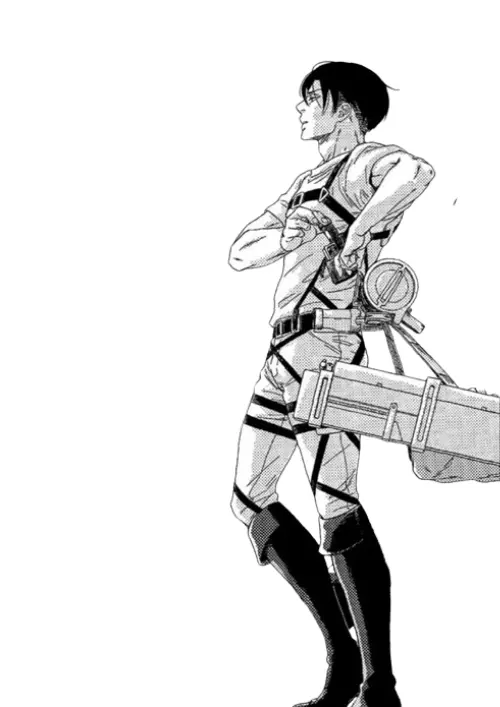
The most physically capable human alive. Levi's program is the hardest calisthenics program in the AoT catalog built on the pull strength, core power, and explosive movement of someone who kills Titans for breakfast.
Every phase, every session, every exercise — expand a day to see the full prescription.
Bilateral strength base and short isometric holds — technique first, with plenty left in the tank (target RIR 3). Grip and pulling variety is introduced early (wide pull-up-style vs. chin-up-style, both assisted where needed) rather than saved for later, matching how the legacy source itself varied grip across the week from day one.
Bilateral movements become unilateral, holds get meaningfully longer, and conditioning shifts from steady pacing to real interval density. Effort tightens (target RIR 2) — the first real test of control under fatigue, not just under load.
Peak complexity: archer push-ups give way to handstand push-ups, bulgarian split squats give way to pistol squats, and the pulling ladder built since week 1 pays off in muscle-up work. Target RIR reaches 1 and interval rest bottoms out. The final week of this arc is a deliberate deload — same movements, roughly 10-15% lighter volume and slightly longer rest — before repeating this arc at a higher level or moving to a new program.
This program isn't built around volume or size — it's built around control. Every session treats a movement done with full control as more valuable than the same movement done sloppily for more reps. That shows up as unilateral work (one side has nowhere to hide), extended isometric holds (there's no momentum to fake), and a pulling emphasis that's varied by grip and angle rather than repeated identically. Nothing here chases size for its own sake — it chases the kind of strength that looks effortless because it's completely under control.
A compact, strength-dense frame — visible control and definition from unilateral and isometric work, not added bulk. Think gymnast or elite calisthenics athlete, not powerlifter.
Elite relative strength (pull-ups, dips, muscle-ups), full-body control under isometric load, and the grip and core stability that supports fast, precise movement under fatigue.
Two mechanisms do most of the work here, plus a third for conditioning. Bodyweight strength movements (pull-up/chin-up variants, dips, squats) use rep progression within an arc, then swap to a harder variant of the same movement family the next arc once reps stop being a real challenge — assisted pull-up becomes pull-up becomes chin-up-with-added-range, feet-elevated push-up becomes archer push-up becomes handstand push-up, bulgarian split squat becomes pistol squat. Isometric holds (plank, horse stance, L-sit) use the same rep-progression-then-tier-swap logic, just measured in seconds instead of reps — hold time climbs within an arc, then the next arc either extends the target further or introduces a harder hold variant. Sprint intervals use density progression: the same number of rounds gets harder purely by cutting rest between them, never by adding volume. Target RIR drops 3 to 2 to 1 across the three arcs on effort-based strength work, exactly like the drop in intensity that's supposed to happen approaching a program's peak phase — but RIR is deliberately left off every isometric hold, every jump, and every sprint interval, where 'reps in reserve' doesn't mean anything real. Tempo (3-1-1: 3s eccentric, 1s pause, 1s concentric) appears only on archer push-up, pistol squat, and handstand push-up — the three movements in this program where losing control of the eccentric is the same as failing the rep, which is the entire point of training them.
Levi's reputation isn't built on size — it's built on economy of motion. Every real-world translation of his training starts from the same idea: strength that's fully under control, applied with zero wasted effort. That means relative strength over raw mass, precision over volume, and enough grip and full-body control that difficult positions stop being a problem.