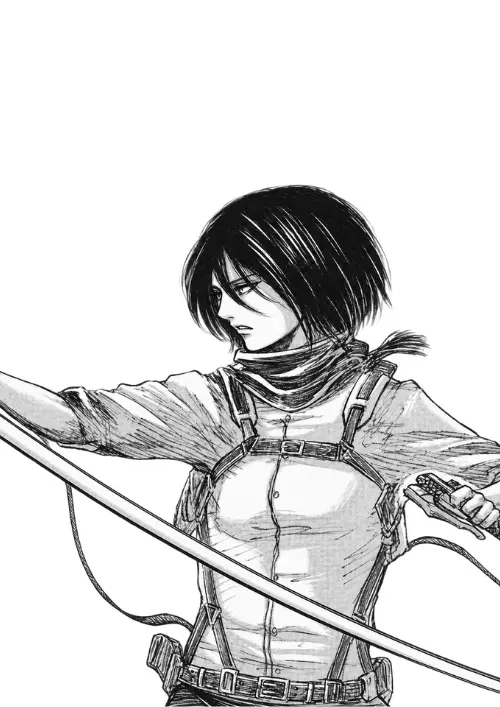
The second strongest human, separated from Levi only by experience. Mikasa's program combines her extraordinary natural gifts with the specific conditioning of an ODM gear specialist.
Every phase, every session, every exercise — expand a day to see the full prescription.
Bilateral strength base and assisted unilateral leg work — technique first, plenty left in the tank (target RIR 3). A dedicated pulling day is trained from week 1, not saved for later.
Assisted pistol squats give way to real single-leg reps, archer push-ups debut, and conditioning density rises. Effort tightens to target RIR 2.
Peak unilateral leg volume, handstand push-up debuts on the pulling day, and conditioning density reaches the shortest rest of the program. Target RIR reaches 1 — echoes her card's own "second strongest human" framing as the program's final, hardest phase.
Efficiency is the whole point here — every session is built around movements that expose and fix imbalance rather than let it hide, which is why unilateral leg work leads every phase. Pulling strength and core control round out the week, but nothing in this program repeats a session just to fill a training day.
A lean, athletically balanced frame with real unilateral leg development — visible strength and symmetry, not added bulk.
Genuine single-leg strength (pistol squat, bulgarian split squat), real pulling power, and the kind of full-body control and conditioning that shows up as efficient, repeatable movement under fatigue.
Bodyweight strength movements use rep progression within a phase, then swap to a harder variant the next phase once reps stop being a real challenge — assisted pistol squat becomes pistol squat, push-up becomes archer push-up, assisted pull-up becomes pull-up. Isometric holds (hollow hold, L-sit, plank) use the same rep-progression-then-tier-swap logic, measured in seconds instead of reps. Conditioning work (sprint intervals, jump rope, broad jump) uses density progression: the same or slightly higher volume gets harder purely by cutting rest, never by adding random extra volume. Target RIR drops 3 to 2 to 1 across the three phases on effort-based strength work; it's deliberately left off every hold, jump, and sprint interval. Tempo (3-1-1) appears only on archer push-up, pistol squat, and handstand push-up — the movements where eccentric control is the whole point.
Mikasa's training identity isn't Levi's — it's her own. Where his real-world translation is built around isometric control and pulling variety, hers is built around unilateral leg strength (a single leg has nowhere to hide) and movement efficiency — every rep looks the same as the last because nothing is wasted. Pulling strength and core control round it out, but the leg work leads every phase.